
What it looks like
A Gen-X zine. Essays, photos, playlists, comics. Everyone writes under a handle and a birth-year suffix — Angel Eyes '73, JC '70, Lupa Ganaram '70, Nell '70 — and emails their work to an inbox. There is no CMS to log into. No drafts. No editor dashboard. You send a thing, the thing shows up.
How a post lands
Plain text in the body for an essay. Image attached for a photo. Apple Music or Spotify share-link for a playlist. Script for a comic.
The intake bus reads the inbox, classifies what came in, generates artwork where artwork is needed (using a locked reference image of the contributor so panels stay visually consistent across their posts), and ships the formatted page. Send to live is usually a couple of minutes.
The contributor never sees a CMS. Submission is the publishing flow.
What's underneath
The interesting part isn't the zine. It's that the site has its own AI — that's the AI tab — and the AI's working context gets re-baked every time a new post goes up. Nopey, the bot you talk to here, is not generic. Nopey knows what is on this site, who writes here, what has been said, where it links. When somebody posts something tomorrow, Nopey will have read it before you ask about it.
Same pipeline that publishes the post tells the AI the post exists. They are the same act.
That's the framework.
The stack is small on purpose. A static HTML/CSS/JS frontend on Firebase Hosting. A Python intake bus running on a Mac mini at the house, polling the inbox every two minutes and pushing accepted submissions via the same Firebase deploy that ships the rest of the site. A Cloud Run service for the AI tab. Two AI providers do the actual work — Anthropic's Claude Sonnet 4.6 powers the chat with prompt caching turned on, so the site's entire current context (every post, every byline, every link) sits warm and gets read on nearly every reply. The same model classifies and replies to inbound mail on the intake side — different prompt, same brain. Google's Gemini 3 Pro Image Preview handles image generation: comic panels, response art, anything the framework needs to draw. Each contributor has a locked reference photo on file so faces and likenesses stay consistent across scenes. Two providers, one Mac mini, no CMS.
How it came together
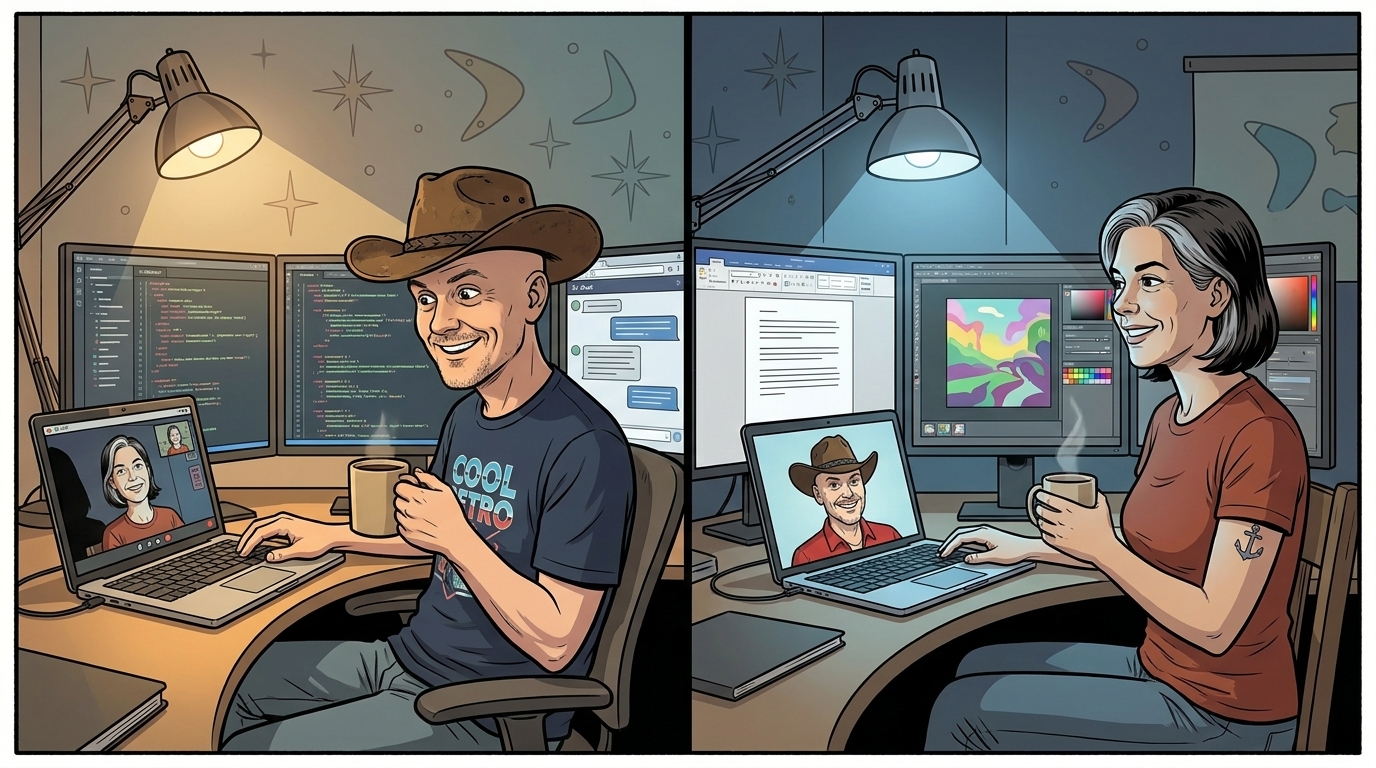
The zine belongs to Angel Eyes '73. The founding post is hers, the name is hers — Chameleon Generation came out of her mouth at fifty-two, talking to her sixteen-year-old. She and JC '70 built the site together over a stretch of mid-2026, both at their multi-screened desks, both with coffee, both running their own AI agents, often on FaceTime while one of them was working out what to prompt next. The engineering is his. The voice is hers. The framework above this point is what they made because she had something to say and he wanted to build the place to say it from.
Why it matters somewhere else
On a zine this size, a chat with the site is a parlor trick. There isn't that much to know yet. You could read the whole thing in an afternoon.
On any other kind of site, it is a different tool. A small business. A consulting practice. A documentation site. A long-running blog. A directory. A portfolio. Anywhere the visitor's first question is some flavor of is this for me? or what do you have on X? — there is real value in a site that can answer in its own voice, with its own facts, refreshed continuously, without anyone hand-editing a knowledge base.
The site you are reading is also the site that talks back. Same content, two surfaces.
What it isn't
Not a CMS. Not a chatbot bolted onto a static site. Not a wiki anyone has to maintain. Just one content path — submission in, formatted page out, AI context updated — wired so the second part follows from the first automatically.
We are starting with a zine because zines are honest. Voice is the whole product. If the framework cannot carry voice, it cannot carry anything.
Curious about the framework on your site
Talk to Nopey, or email contact@chameleongeneration.com.